

Plot
A mysterious game that draws players into a perilous and unpredictable world is the focal point of the fantasy-adventure tale Jumanji. After the game starts, participants have to cooperate, solve riddles, and overcome lethal obstacles in order to survive.
The game becomes a video game in the current iterations of the franchise, when players take on the role of avatars with special skills and flaws. As characters face both external threats and their own concerns, the narrative centers on survival, cooperation, and personal development.
Cast
The Jumanji franchise boasts a solid ensemble cast that infuses the narrative with humor, action, and emotional nuance. The trip is made more balanced and entertaining by each actor’s portrayal of a character that embodies a distinct personality type.
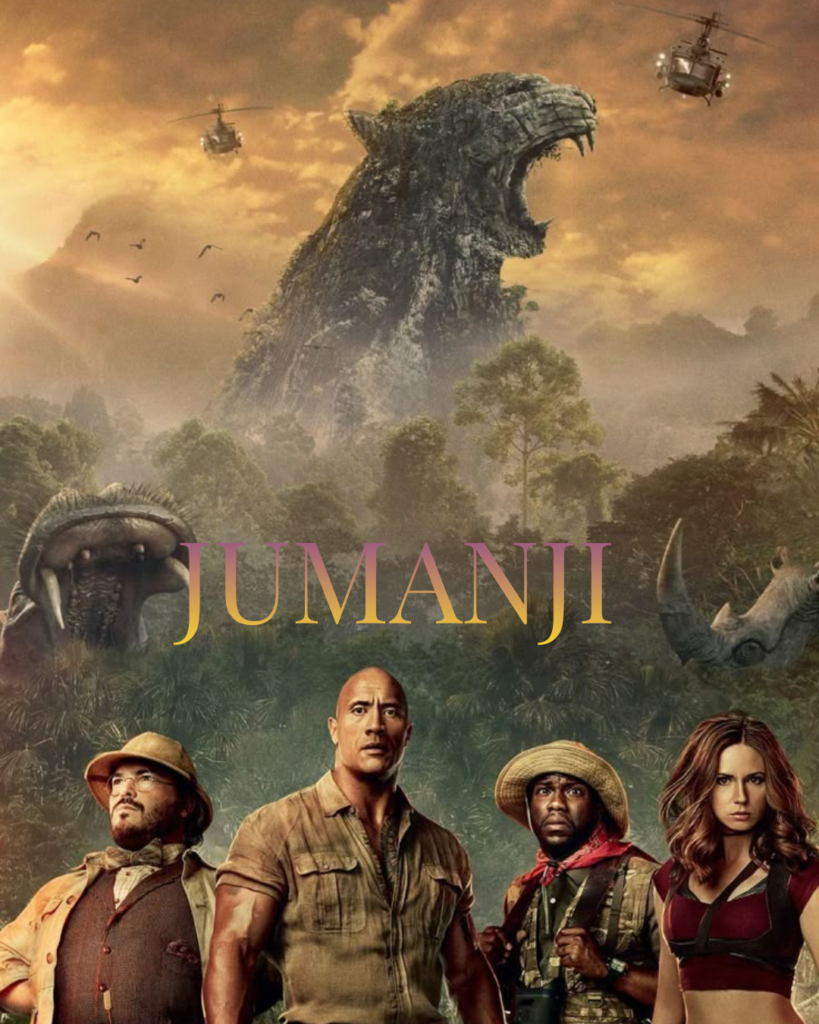
One of the primary reasons the franchise attracts to audiences of all ages worldwide is the performances. Dwayne Johnson as Dr. Xander “Smolder” Bravestone: Eddie’s avatar at first, then Spencer’s avatar once more. He assumes the persona of a powerful, self-assured explorer and archaeologist who now has the vulnerability of avoiding Switchblade.
In a flashback, Zachary Tzegaegbe plays the young Bravestone’s father, Jonathan Bravestone.
Professor Sheldon “Shelly” Oberon, played by Jack Black, is Fridge’s new avatar and a playable character. The avatar is temporarily under Martha’s power before becoming Bethany’s once more. Professor Oberon is shown as an obese guy with expertise in a variety of scientific disciplines, such as geometry and cartography, who is now vulnerable to heat, sun, and sand.
Kevin Hart plays Franklin “Mouse” Finbar, a player character that first appears as Milo’s avatar before switching back to Fridge’s.
Ruby Roundhouse, played by Karen Gillan, is Martha’s avatar and a player character. She is a skimpily dressed commando who is skilled in martial arts and learns how to utilize nunchuks. For a moment, Fridge controls her.
Jefferson “Seaplane” McDonough, played by Nick Jonas, is a player character and Alex’s avatar once more who assumes the shape of an airplane pilot.
Awkwafina as Ming Fleetfoot: Spencer’s new avatar and a new Jumanji player character, who then becomes Eddie’s avatar. Fleetfoot manifests as a burglar with expertise in lock picking, pickpocketing, and burglary, as well as a vulnerability to pollen.
Danny DeVito plays Edward “Eddie” Gilpin, Spencer’s grandfather, who is upset that Milo sold the café they jointly owned. Rory McCann plays Jurgen the Brutal, a ruthless Jumanjian warlord who killed Bravestone’s parents.
Eddie’s pal Milo Walker, played by Danny Glover, fell out with him after he sold their cafe.
Spencer Gilpin, played by Alex Wolff, is a fresh college student who finds it difficult to fit in with Martha’s boyfriend.
Martha Kaply, played by Morgan Turner, is Spencer’s girlfriend and a recent college student.
Anthony “Fridge” Johnson, played by Ser’Darius Blain, is a new college student and Spencer, Martha, and Bethany’s acquaintance.
Madison Iseman plays Bethany Walker, a recent college student who is now a travel influencer and one of the four friends that went through the previous Jumanji.
Nigel Billingsley, played by Rhys Darby, is an NPC who acts as the main player guide.
Alex Vreeke, played by Colin Hanks, is a former Jumanji player who is now a parent.
Eddie’s daughter and Spencer’s mother, Janice Gilpin, is portrayed by Marin Hinkle.
Dorothy Steel is the village elder, and Vince Pisani is the pharmacy manager.
Bebe Neuwirth plays Nora Shepherd again, the aunt of Peter and Judy Shepherd, the main characters in the original movie, who tried to convert the Parrish House into a bed and breakfast.
Jennifer Patino plays Bravestone’s mother in Jumanji, Massi Furlan plays the criminal boss Switchblade, who is Bravestone’s vulnerability, Dania Ramirez plays Switchblade’s alluring wife, John Ross Bowie plays Jurgen’s butler Cavendish, and DeObia Oparei plays an elevator guard. Lucy, Danny DeVito’s daughter, also plays a maiden NPC. Janice calls a heater repairman, played by Lamorne Morris.
Production
Jumanji’s production placed a strong emphasis on fusing fantasy and contemporary visual effects. Filmmakers sought to update the original idea for modern audiences while maintaining its sense of adventure.
The immersive gaming world that characterizes the franchise was created using sophisticated computer-generated imagery, realistic effects, and thoughtfully created settings.
Sony started working on the sequel after Jumanji: Welcome to the Jungle was released. Rosenberg and Pinkner wrote the script once more, while Johnson, Hart, Black, and Gillan reprised their roles in Kasdan’s follow-up. Due to Zathura: A Space Adventure (2005), which is the second movie in the series and shares continuity with the others, Black acknowledged that the new movie is a fourth Jumanji movie. Jumanji: Welcome to the Jungle is the third movie. Kasdan claims that the movie’s working title was J-19. Jumanji: The Next Level was revealed as the movie’s title.
Release
When Jumanji films were released in various parts of the world, families and fans of adventure films took a keen interest in them. Every release drew both new viewers who were unfamiliar with the franchise and nostalgic viewers who were familiar with the original plot.
The franchise’s global release strategy contributed to its tremendous appeal.
Reception
Audiences responded favorably to the Jumanji franchise because of its inventiveness, humor, and entertainment value.
Box Office
One of the most popular adventure franchises in its genre, Jumanji did well at the international box office. Long theatrical runs were facilitated by the pictures’ appeal to families and return viewers.
Critical Response
The franchise was commended by critics for its entertaining storytelling, captivating acting, and capacity to update a traditional idea. The majority of reviews emphasized the movie’ entertainment value and wide appeal, even if some pointed out predictable features.
Honors
The visual effects, performances, and family-friendly narrative of the Jumanji films earned them multiple nominations and awards.
The sequel
Jumanji extended into several sequels as a result of its commercial success and high fan demand. Future installments are still being discussed because the franchise is still well-liked and attracts a lot of search traffic.
Concluding Remarks
Jumanji is a unique series that combines humor, adventure, fantasy, and important life lessons. Its changing premise and structured storytelling have contributed to its continued relevance across generations.